

Hidden within the rugged landscapes surrounding Petra, a new archaeological mystery is quietly unfolding—one that adds another layer of intrigue to Jordan’s already rich prehistoric heritage.
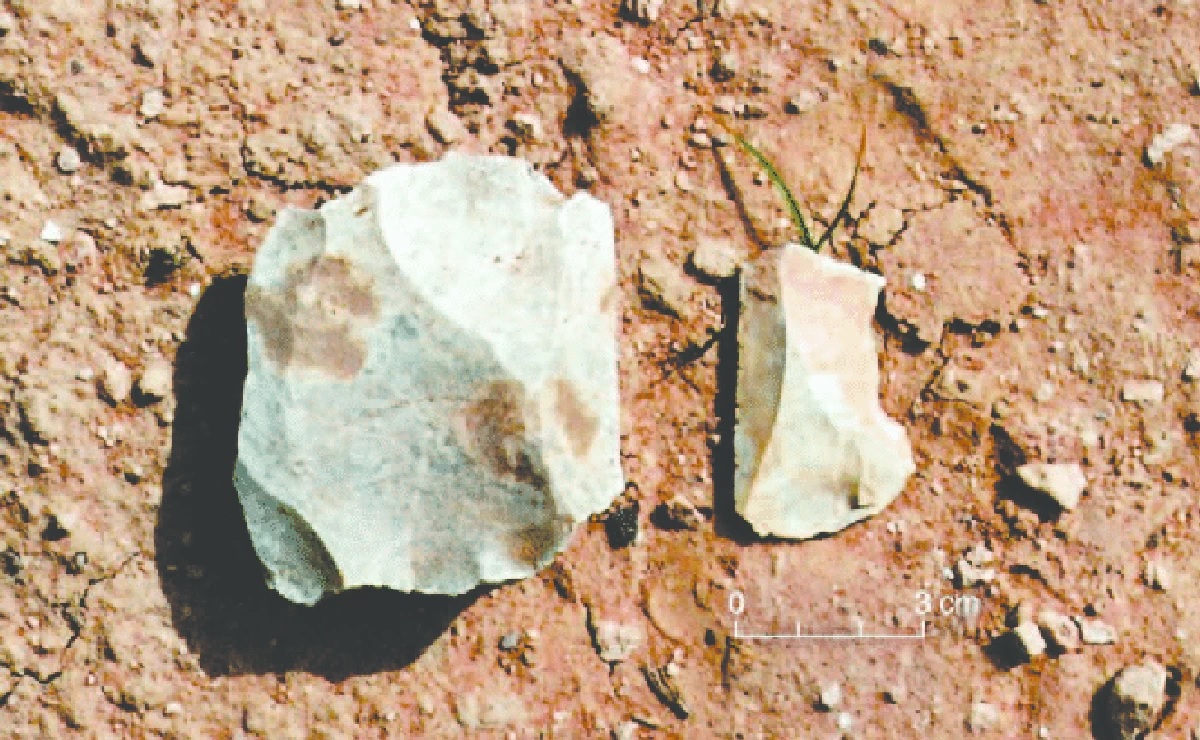
Researchers exploring the Petra hinterland have uncovered a scattering of rare Middle Palaeolithic artefacts resting on the surface of ancient deposits dating back to the Late Pleistocene. These finds, though limited and isolated, hint at human activity in the area far earlier than previously understood. However, their exact origin remains elusive, leaving scientists with more questions than answers.
The discoveries were made near Al Ansab, where heavy seasonal rains are believed to have washed the artefacts down from higher ground, revealing them along the eastern slopes of ancient wadi deposits. According to archaeologist Daniel Schyle of the University of Cologne, attempts to trace these artefacts back to their original context have so far been unsuccessful. Instead, researchers repeatedly encountered small clusters of tools displaced by erosion and resting on sterile sediment layers.
What began as a few scattered pieces soon led to the discovery of a densely packed “pocket” of artefacts embedded in a steep slope. Nearly free of surrounding sediment and covered by loose sand, the site posed significant excavation challenges, with material constantly shifting downslope. Despite these conditions, archaeologists confirmed that the concentration was limited in extent and did not continue deeper into the surrounding deposits.
Most of the recovered items consist of debitage—flakes and by-products of stone tool production—along with a single identifiable tool known as a burin. These artefacts are associated with a distinctive technology involving hard-hammer striking techniques used to produce large, pointed blades.
Interestingly, similar technological features have been documented at other sites in Jordan, including Tor Sadaf and locations in Wadi Aghar and Gebel Qalkha. Comparable discoveries have even been reported as far afield as Wadi Surdud in Yemen, suggesting possible regional connections or parallel technological developments across the Arabian Peninsula.
Yet, despite these parallels, the Petra finds remain difficult to classify. The artefacts appear in a secondary position—displaced from their original layer—and are found above the Early Ahmarian occupation level, adding further complexity to their interpretation. This unusual placement raises important questions about ancient environmental processes and human activity in the region.
For travelers, these findings offer a fascinating reminder that Jordan is not only home to iconic monuments but also to ongoing discoveries that continue to reshape our understanding of early human history. Beyond the rose-red façades of Petra lies a vast and largely untapped prehistoric landscape—one that still holds secrets waiting to be uncovered.